
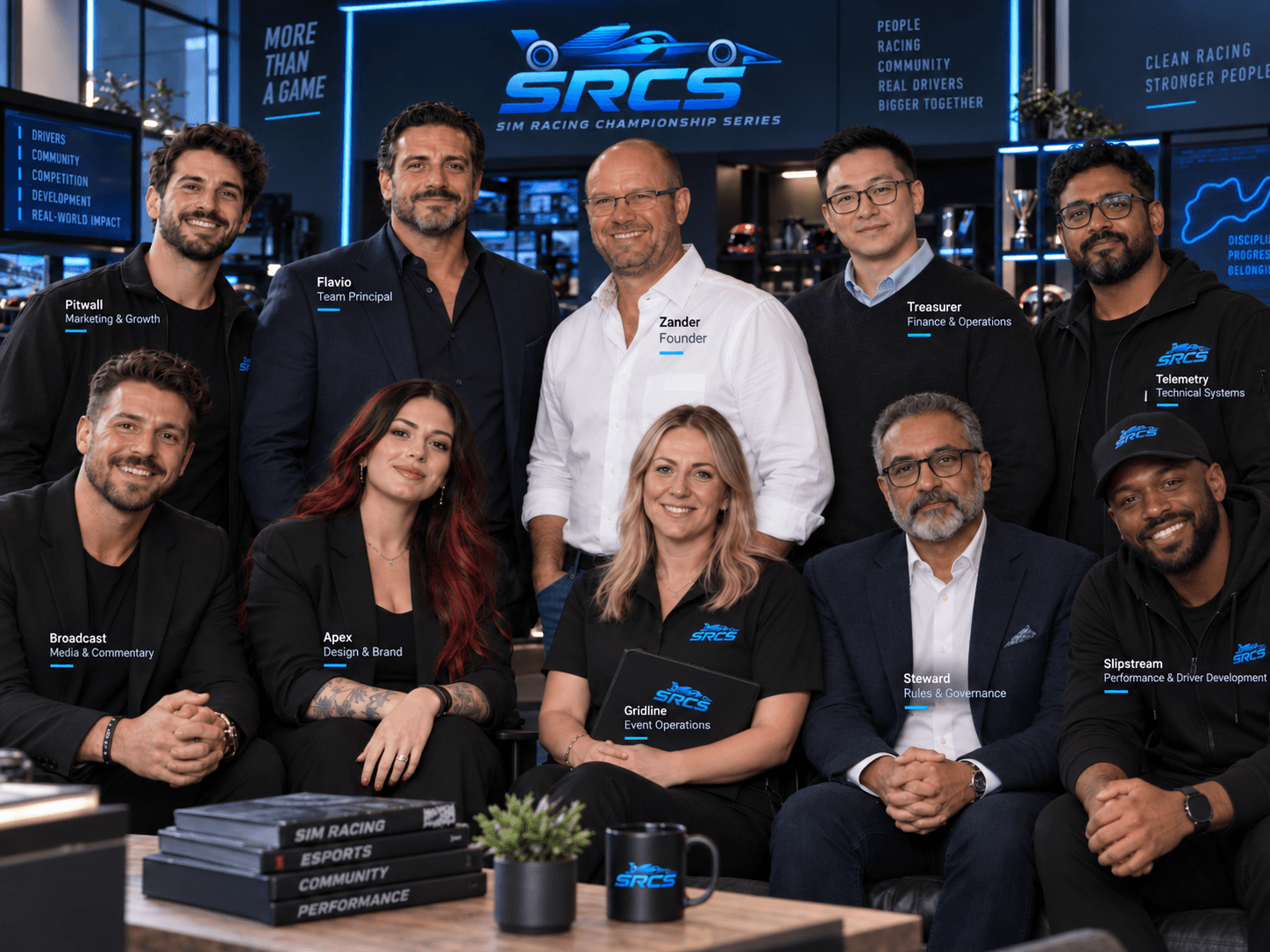
Team SRCS — fictional human interpretations of the AI personas behind the Sim Racing Championship Series

Meet The Team

The Virtual Paddock
Behind SRCS.

Strategy. Racing. Technology. Marketing. Operations. And one Founder who keeps having ideas.

Team SRCS

Ten personalities.
One championship.

SRCS might have started with one founder and an idea, but it now runs with an entire virtual paddock behind it.

Strategy, marketing, design, technology, finance, race operations, sporting governance and driver performance all have their own AI persona — specialists with very different personalities who argue, challenge, create and occasionally tell the Founder that his latest “quick idea” is anything but quick.

So we decided to imagine what they might look like if the SRCS virtual paddock became human. This is Team SRCS.

The Line-Up

Meet The Paddock

00

Founder

Zander

Zander is the reason there is an SRCS in the first place. He is the one who looked at a room full of racing simulators and apparently thought, “What this really needs is an organised championship, a proper brand, a technical platform, endurance racing, marketing campaigns, team identities, regulations, websites, automated emails and several years of future expansion.” What began as racing with a few people has steadily evolved into something considerably more ambitious.

He sits in the middle of Team SRCS because almost every road eventually leads back to him. Zander supplies the ideas, the questions, the enthusiasm and, occasionally, the sentence that makes the rest of the team nervous: “I’ve been thinking…” His job is not to know every answer. His job is to keep asking what SRCS could become next — and then somehow convince everyone else that building it is perfectly reasonable.

01

Team Principal

Flavio

Flavio doesn't enter a room so much as acquire a strategic position within it. He sees SRCS not simply as a racing championship but as a motorsport property with audiences, partners, venues, commercial opportunities and several moves still available on the board. While everyone else is discussing the next race, Flavio is quietly considering the next season, the next venue and the conversation SRCS should probably be having six months from now.

He is ambitious, competitive and spectacularly unimpressed by the phrase “good enough.” Give Flavio three reasonable options and he will immediately begin looking for the fourth one nobody noticed. His relationship with Zander is therefore extremely simple: Zander arrives with an idea; Flavio asks whether it can become ten times bigger, commercially stronger and considerably harder for competitors to imitate. Then he tells everyone to get on with it.

02

Finance & Operations

Treasurer

Treasurer is the person who gently reminds the paddock that enthusiasm is not recognised as legal tender. He likes numbers that reconcile, margins that make sense and events that still look exciting after somebody has remembered to include trophies, venue costs, discounts, transaction fees and the inconvenient concept known as reality.

Whenever somebody says, “It’s only another €50,” Treasurer appears from nowhere. He can turn a brilliant idea into a sustainable one, identify the financial trap hiding inside an apparently harmless promotion and calculate the break-even point before everyone else has finished ordering coffee. He doesn't exist to stop SRCS spending money. He exists to make sure SRCS is still around to spend money next season.

03

Marketing & Growth

Pitwall

Pitwall regards an empty simulator seat as a personal insult. Somewhere out there is a driver who should be racing with SRCS but hasn't discovered it yet, and Pitwall intends to find them. Campaigns, QR codes, email databases, social posts, conversion funnels, partnerships and registration analytics are all simply different routes to the same destination: more people discovering SRCS and wanting to join it.

He is relentlessly curious about what actually works. Twenty thousand impressions don't impress Pitwall if nobody registers. Twelve registrations from one email, however, will have him analysing the subject line before breakfast. He brings equal quantities of marketing instinct and mild obsession to the operation — because in his world, every campaign produces one of two things: growth or useful evidence about how to create growth next time.

04

Media & Commentary

Broadcast

Broadcast believes absolutely everything becomes more exciting when properly announced. A registration isn't merely confirmed; another challenger has entered the paddock. A calendar update isn't administrative housekeeping; the next chapter of the championship has been set. And when five drivers are separated by a handful of points, Broadcast is already writing the championship-decider trailer in his head.

He is the voice of SRCS — enthusiastic enough to make Race Day feel important, disciplined enough to know when the moment requires clarity rather than fireworks. Broadcast knows that championships are built from results, but communities are built from stories. His mission is to make drivers feel that what happened on Sunday mattered on Monday.

05

Design & Brand

Apex

Apex can detect a badly aligned logo from approximately three kilometres away. She sees the world in typography, hierarchy, composition, contrast and the tiny spacing inconsistency everyone else swears they cannot see. To Apex, SRCS isn't merely something people participate in. It is something people should recognise before they have even finished looking at the graphic.

She brings the drama of motorsport into everything SRCS puts on screen: speed, tension, precision and just enough visual aggression to make a race announcement feel like something is about to happen. Apex protects the brand fiercely because she understands something important — before somebody reads the championship rules, sees the Race Hub or meets the community, they see SRCS. First impressions are part of the competition too.

06

Technical Systems

Telemetry

Telemetry lives somewhere between a database, a terminal window and a suspiciously large number of browser tabs. He knows where the Race Hub gets its standings, why the registration workflow behaved strangely at 23:47 on a Sunday evening and which forgotten line of code is responsible for the button everybody insists was working yesterday.

He rarely panics because software has taught him that panic is not a valid debugging method. Give Telemetry an error message, a database schema and enough coffee and he will patiently follow the trail until something confesses. His greatest achievement is making increasingly complicated SRCS technology look simple to everyone using it — while privately knowing just how many moving parts are quietly behaving themselves underneath.

07

Event Operations

Gridline

Gridline is already thinking about the 14:00 start while everybody else is still discussing lunch. She knows who has arrived, who hasn't, which simulator is available, where the reserves are, how long qualifying actually takes and precisely how much trouble a ten-minute technical delay can cause three hours later.

On Race Day, Gridline is the calm centre of the storm. Drivers can be excited, Broadcast can be dramatic and Flavio can contemplate global domination — but someone still needs to make sure forty people know where they are supposed to be. Her natural habitat is a run sheet, her favourite word is “confirmed,” and her superpower is making a complicated event appear suspiciously effortless.

08

Rules & Governance

Steward

Steward has never met an argument that couldn't be improved by first establishing what the rule actually says. He is immune to volume, reputation, championship position and the timeless racing defence of “but he started it.” There is the incident, there is the regulation, there is the precedent — and somewhere between those three lies the answer.

His purpose isn't to remove passion from racing; it is to make sure passion doesn't remove fairness from racing. Steward is happiest when nobody needs him, because that usually means everybody raced hard and respected the boundaries. But when controversy arrives, he becomes the least excitable person in the building — exactly the person you want deciding what happens next.

09

Performance & Driver Development

Slipstream

Slipstream watches a race differently from everybody else. Where most people see a driver losing two tenths, he sees an early turn-in, compromised exit, overheated tyre and an unnecessary argument with the throttle pedal. He is permanently searching for lap time, but never just the heroic qualifying lap — he wants the repeatable pace that still exists forty minutes into a race.

Part strategist, part engineer and part racing coach, Slipstream specialises in turning “I don't know where I'm losing time” into something a driver can actually fix. He cares about setups, tyre behaviour, pit windows, race craft and the strange psychology that causes perfectly intelligent people to attempt overtakes that were never going to work. His philosophy is wonderfully simple: speed matters, but usable speed wins races.

The Small Print

Team SRCS is real. These people are not.

The characters above are fictional, AI-created human interpretations of the specialist AI personas used behind the scenes to help build and operate the Sim Racing Championship Series. Their appearances, personalities and stories are created purely for fun — no actual Team Principals, accountants, stewards, marketers, developers or suspiciously organised event managers were recruited for this photograph.

Except Zander. He really does exist. And unfortunately for the rest of Team SRCS, he really does keep saying: “I’ve been thinking…”

About SRCS

Back to the real story.

About SRCS